

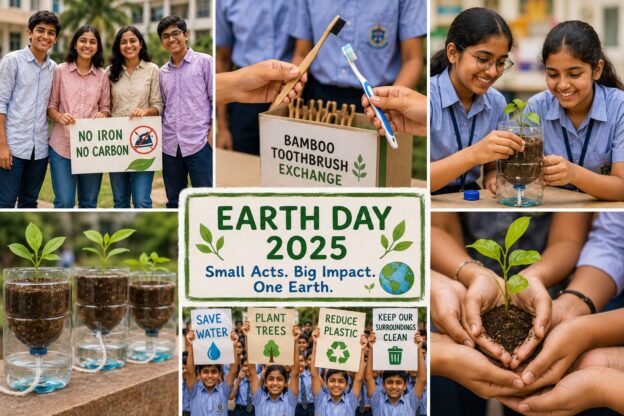
Most schools mark Earth Day with a poster competition and a PowerPoint about polar bears. Zebar School for Children had a different idea.
On April 22, 2025, the Zebar campus looked — and felt — unlike any other day of the year. Shirts were creased. Old toothbrushes changed hands. Small green saplings sat in halved plastic bottles, quietly drinking water through threads. And thousands of students, teachers, and parents had collectively chosen to do something harder than planting a tree: they had chosen to change a habit.
This is the story of Zebar’s Earth Day 2025 — led by the Interact Club, rooted in purpose, and built on the belief that small acts, multiplied by many people, can genuinely move the needle.
👕 No Iron Day — The Crumple Revolution
Here’s a fact that most of us have never had reason to think about: ironing a single pair of clothes generates up to 200 grams of carbon emissions. Not from driving. Not from flights. From the humble iron sitting on your ironing board.
Now multiply that by millions of homes doing it every single morning, and you begin to understand why Zebar decided to put the iron away — at least for one day.
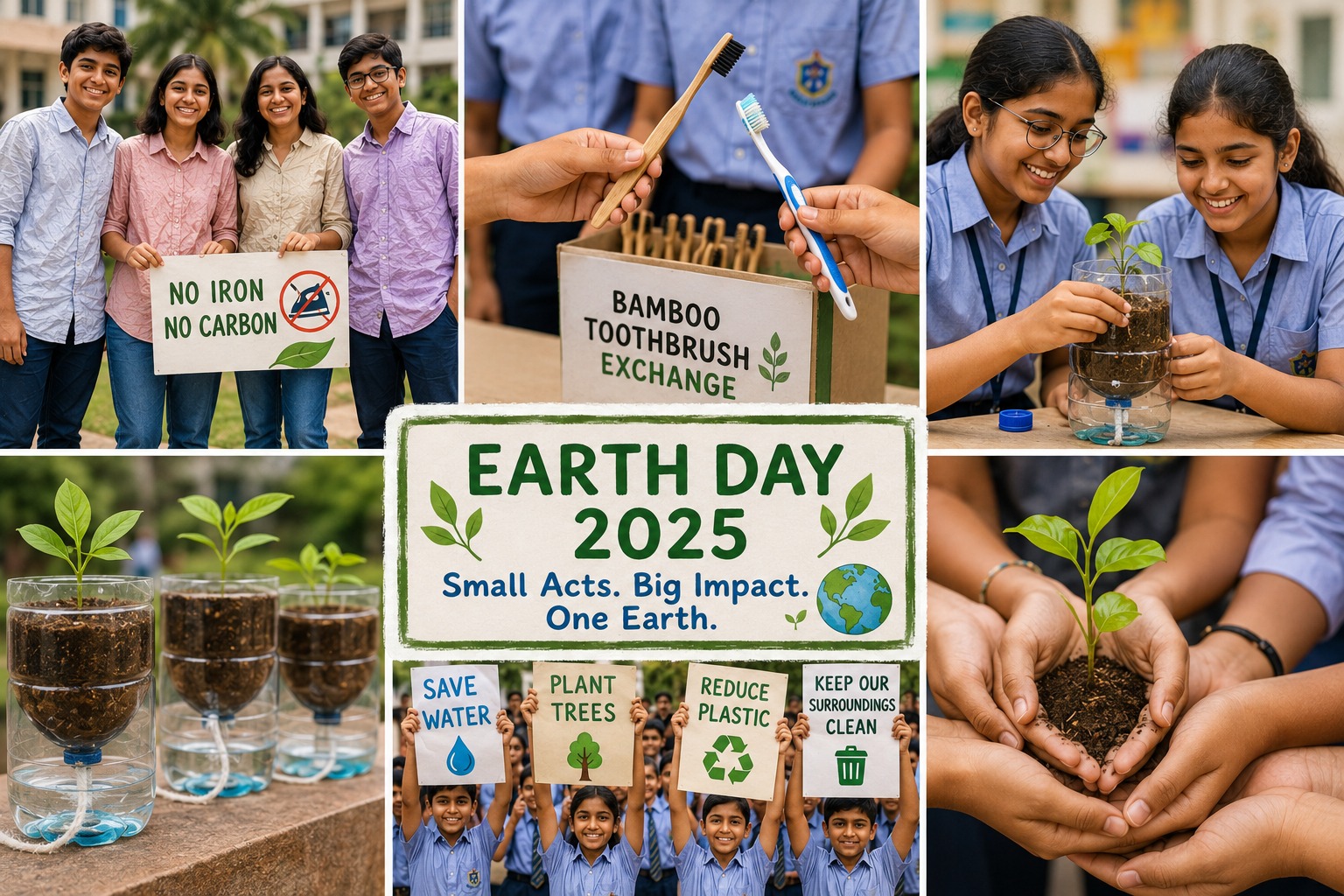
On 22nd April, students, teachers, and parents arrived in gloriously crumpled clothes — and the school had never looked better.
No Iron Day was not just a quirky initiative. It was a carefully chosen act of collective consciousness. By skipping the iron, the Zebar community sent a message that resonates far beyond the classroom: that sustainability is not always about grand sacrifice — sometimes, it lives in the choice you make before you leave the house in the morning.
The slogan echoed through hallways: No Iron. No Carbon. And a ripple of understanding spread — that the environment isn’t only at stake in forests or oceans. It is at stake in our kitchens, our bathrooms, and our wardrobes too.
The Bamboo Toothbrush Exchange — Swapping Plastic for the Planet
The first plastic toothbrush ever manufactured is, in all likelihood, still sitting in a landfill somewhere. Intact. Undegradable. Waiting out its 400-year lifespan while we’ve all moved on.
Most of us don’t think about our toothbrushes. We buy them at the convenience store, use them for a few months, and toss them without a second thought. Zebar decided it was time to think.
Students brought their old plastic toothbrushes. In return? A dentist-approved, eco-friendly bamboo toothbrush — for just ₹10.
The bamboo toothbrush exchange was disarmingly simple in its design and powerful in its effect. Beyond the swap itself, the activity opened up a conversation that students carried home: Why don’t we just always use bamboo? It’s softer on gums, durable, cost-effective, and endorsed by dentists. The barrier was never quality — it was habit.
By making the switch tangible, affordable, and fun, Zebar gave its students something more valuable than a toothbrush. It gave them the experience of making a better choice — and the knowledge that better choices exist.
Saplings in Bottles — Where Art Meets Science and Sustainability
Some classroom activities fade with time. This one took root—quite literally.
In Grade 5, under the guidance of art teacher Ms. Sejal Anjaria, students engaged in a plantation activity that went beyond the usual. Instead of simply planting saplings in soil, they designed their own miniature self-sustaining ecosystems using repurposed plastic bottles.
Each bottle was transformed into a two-part system—soil above, water below—connected by a simple thread that carried water upward through capillary action. What might seem like a small design held within it powerful lessons: innovation, resourcefulness, and the science of how nature sustains itself.
A discarded plastic bottle became a planter. A thread became a lifeline. And a sapling became a responsibility.
By taking their creations home, students weren’t just completing an activity—they were committing to nurture life. These weren’t just plants. They were promises in progress.
The Pledge — From Awareness to Action
The day concluded with a quiet but meaningful moment—a collective pledge.
Students came together to commit to protecting the Earth, adopting eco-friendly habits, and carrying these values into their everyday lives.
But this wasn’t a routine recital of words.
Every activity leading up to the pledge had already asked students to act—to rethink, to reuse, to reflect, and to take responsibility. By the time they stood together, the meaning of their words had already been lived.
The pledge wasn’t the highlight of the day. It was its natural conclusion—a reflection of actions already taken and a promise to continue them beyond the classroom.
Simple ideas. Big hearts. One school decided that Earth Day deserves more than a worksheet.
Saving water. Planting trees. Reducing plastic. Keeping surroundings clean. These are not new ideas. But at Zebar, on April 22nd, 2025, they were not just ideas. They were actions.
And actions — small, committed, joyful, repeated — are how the planet gets saved.